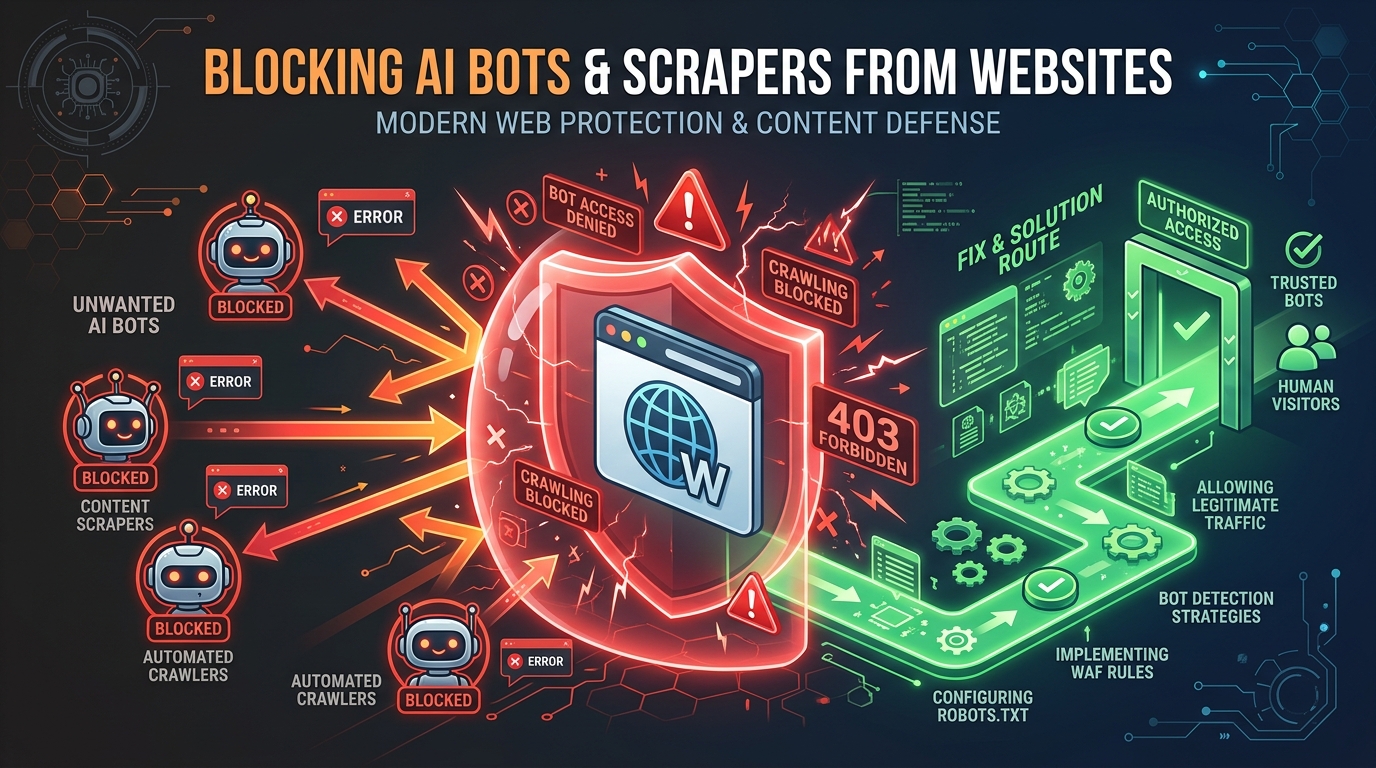

Blocking the wrong bots can cost you AI visibility. Allowing the wrong bots can cost you bandwidth and content. This guide helps you draw the line in the right place.
In this guide you will learn how to diagnose firewalls that silently block AI bots. We will keep it practical, with clear steps, visual breakdowns, and specific actions you can take today. The first step in any AI visibility project is to run a free AI crawler check on your website so you know exactly where you stand against the 196 bots we track across 8 categories.
Key Takeaways
- Is Your WAF Blocking AI Crawlers by Accident? is a practical, repeatable process, not a one-time fix.
- Most AI visibility problems trace back to access, not content.
- You can verify every change with the free AI crawler check and the robots txt validator.
- Document your approach so the whole team applies it consistently.
Blocking Bad Traffic Without Blocking Citations
Security controls and AI visibility pull in opposite directions, so the sequence is designed to keep the two decisions separate rather than letting one silently override the other.
Inventory what is currently being blocked and by what
List the rules in your firewall, CDN and bot-management layer alongside robots.txt. These are usually managed separately and frequently contradict each other, and the security layer always wins.
Verify the identity of the agents you care about
A user-agent string is a claim, not evidence. Confirm legitimate crawlers by reverse DNS or published address ranges before writing rules that trust the header, because spoofing the header is trivial.
Distinguish abusive volume from unwanted purpose
Rate limiting answers a load problem. A robots.txt directive answers a policy problem. Using a block to solve a load problem removes you from answers you wanted to appear in, and it is the most common overcorrection.
Test the external result rather than the config
Run an AI crawler checker from outside your network and confirm the crawlers you intend to allow are genuinely reachable. Configuration review does not catch a rule applied at an upstream layer.
Recheck after every infrastructure change
Bot-management defaults change, CDN features get enabled, and vendors add protections without asking. Validate the file with a robots.txt check and re-scan on a schedule.
Why Accidental Crawler Blocking Is Harder Than It Looks
This failure is common because nothing about it looks like a failure. A protective rule does exactly what it was configured to do, the site stays up, no error appears in any dashboard, and an agent that would have cited you is turned away. There is no exception to investigate, because from the inside a refused request is a success. Traffic that never arrives cannot show up as a drop in traffic that did.
The reason it goes undetected for so long is that every internal check passes. The configuration is correct against its own intent, the page loads for staff, the monitoring is green, and the analytics show no anomaly, because a blocked crawler generates no session to be missing. The only way to find it is to look from outside, using the identity of the agent you care about, at the specific pages that matter. Reading the configuration cannot tell you what the configuration does, and that is the whole difficulty.
The Four Things That Actually Matter About Accidental Crawler Blocking
Test from outside with the identity you care about, on the pages that matter
The only reliable check is to request your own pages the way the agent does and read the status you get back. Fetching the homepage as a browser proves nothing, because rules are usually conditional on the very things a browser does differently. Choose the pages you most want cited rather than the ones easiest to test, since protective rules cluster around forms, search endpoints and anything expensive, which is often exactly where the substance is.
Suspect the generic protections before the bot specific ones
Rules written about bots are usually deliberate and documented. The ones that cause accidental damage are the generic protections: a challenge on requests without ordinary browser characteristics, a rate limit tuned for human pacing, a geographic restriction, or a managed rule set updated by a vendor. None of these mention AI crawlers anywhere, none appear in a review of bot policy, and any of them can refuse an agent that follows every rule you published.
Recheck after every infrastructure change, because the cause is usually a side effect
The block is rarely introduced by someone deciding to block. It arrives as a side effect of a platform migration, a security posture change, a new managed rule set, or a plan upgrade that turns on protection by default. That means the correct trigger for rechecking is not a schedule but an event: whenever anything in the request path changes, retest external access, because the change that caused it will not have been described as a bot policy change.
Distinguish an outright refusal from a challenge, because they fail differently
A refusal is at least visible in your own logs as a refused request. An interactive challenge is worse, because it returns a normal looking response containing no content. An automated client receives something that is technically successful and substantively empty, and your logs record a served request. Any check therefore has to look at what came back rather than only at the status code, since the empty success is the case most likely to be recorded as working.
The Accidental Blocking Failure That Hides in Plain Sight
Auditing the configuration instead of the external result
The tempting approach is to review the rules and confirm none of them mentions the crawler you care about. This is reassuring and close to worthless, because the rules that cause this problem are conditional on request characteristics rather than on identity, and the interaction between several correct rules is not visible in any of them individually. Reading configuration answers what you intended. Only an external request answers what happens, and those two answers differ precisely in the cases worth finding.
How to Prove Your Accidental Blocking Change Landed
The check that matters here: Request a handful of your most citation worthy pages from outside your network as the agent you most want to reach them, and confirm each returns a full page rather than a challenge or an empty success. Repeat it after the next infrastructure change rather than on a calendar.
Where to Go From Here
Accidental Blocking is one piece of a larger picture. The AI bot directory documents every crawler we track with its operator, purpose and safety rating, and the multi-site crawler check audits many sites in one pass if you manage a portfolio.
Blocking hostile scrapers while staying visible to search-and-cite bots is a balance, not a switch. Verify both sides with an AI crawler checker.
Your Accidental Blocking Action Checklist
Five concrete steps, specific to what this guide covered. Work through them in order, changing one thing at a time so you can tell which change produced the result.
- □Establish a baseline with a free AI crawler check and write down the score before you change anything.
- □Apply the single highest-impact change from this guide, on its own, so you can attribute the result.
- □Validate the change with the robots.txt check before it reaches production.
- □Re-measure and compare against your baseline rather than against expectation.
- □Schedule a recurring re-check, because redesigns and security updates quietly undo this work.