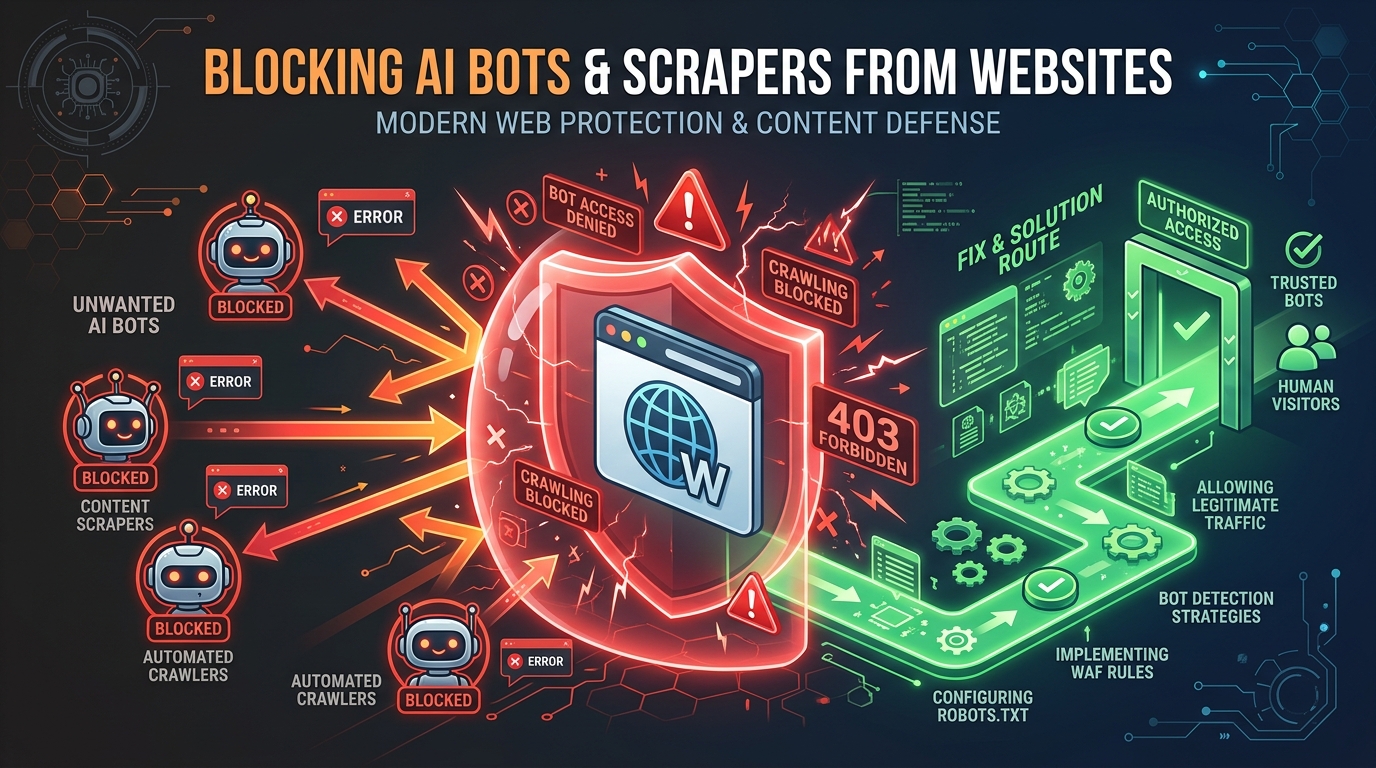

Blocking the wrong bots can cost you AI visibility. Allowing the wrong bots can cost you bandwidth and content. This guide helps you draw the line in the right place.
In this guide you will learn how to stop malicious bots while keeping AI visibility. We will keep it practical, with clear steps, visual breakdowns, and specific actions you can take today. The first step in any AI visibility project is to run a free AI crawler check on your website so you know exactly where you stand against the 196 bots we track across 8 categories.
Key Takeaways
- Block Bad Bots Without Hurting Your AI SEO is a practical, repeatable process, not a one-time fix.
- Most AI visibility problems trace back to access, not content.
- You can verify every change with the free AI crawler check and the robots.txt validator.
- Document your approach so the whole team applies it consistently.
Blocking Bad Traffic Without Blocking Citations
Security controls and AI visibility pull in opposite directions, so the sequence is designed to keep the two decisions separate rather than letting one silently override the other.
Inventory what is currently being blocked and by what
List the rules in your firewall, CDN and bot-management layer alongside robots.txt. These are usually managed separately and frequently contradict each other, and the security layer always wins.
Verify the identity of the agents you care about
A user-agent string is a claim, not evidence. Confirm legitimate crawlers by reverse DNS or published address ranges before writing rules that trust the header, because spoofing the header is trivial.
Distinguish abusive volume from unwanted purpose
Rate limiting answers a load problem. A robots.txt directive answers a policy problem. Using a block to solve a load problem removes you from answers you wanted to appear in, and it is the most common overcorrection.
Test the external result rather than the config
Run an AI bot access checker from outside your network and confirm the crawlers you intend to allow are genuinely reachable. Configuration review does not catch a rule applied at an upstream layer.
Recheck after every infrastructure change
Bot-management defaults change, CDN features get enabled, and vendors add protections without asking. Validate the file with a robots checker and re-scan on a schedule.
What Is Really Going On With Selective Bot Blocking
Bot blocking goes wrong because two different complaints get answered with the same control. One complaint is about volume: something is consuming bandwidth or distorting analytics. The other is about purpose: someone is using the content in a way you did not agree to. These have almost nothing in common, but both arrive as a request to block bots, and a single rule aimed at both usually solves neither while removing an agent that was sending qualified readers.
The asymmetry in the consequences is what deserves the caution. Failing to block an abusive scraper for another month costs some bandwidth and some noise in the reports, and the cost stops when the rule lands. Accidentally blocking a retrieval agent costs citations for as long as the rule stands, and it is discovered late, because nothing breaks and no alert fires. Traffic that never arrives leaves no trace. So the two error directions should not be treated as equally acceptable, and the default when the evidence is thin should lean toward allowing.
The Four Things That Actually Matter About Selective Bot Blocking
Separate the volume complaint from the purpose complaint before writing a rule
Ask which problem you actually have, because the instruments differ. Volume is a rate problem and rate limiting is the matching tool, since it preserves access while capping cost. Purpose is a permission problem, and the matching tools are robots.txt for cooperative agents and an edge rule for the ones that ignore it. Blocking is a poor answer to a volume complaint, and rate limiting is a poor answer to a purpose complaint. Naming the complaint first is what stops a mismatched control being deployed.
Sort the catalogue by what the agent does with the page, not by whether it is an AI bot
The useful distinction is between an agent that reads the page to answer someone who is asking about you right now, an agent that reads it to train a model, and an agent that is fetching in bulk for its own product. The first sends readers and is the one to protect. The second is a policy decision with lasting consequences. The third is usually the one people mean by bad bots. Lumping all three together as AI traffic is what produces rules that block the citation source and keep the scraper.
Distrust the agents recorded as inconsistent more than the ones recorded as ignoring rules
An agent documented as not honouring robots.txt is at least predictable, so you know an edge control is required. The harder group is the one recorded as inconsistent or unknown, and it is not small. For those, a file directive may work today and not next month, with no notice either way. Anything you genuinely need enforced belongs at the edge where compliance is not optional, and robots.txt should be reserved for stating intent to the agents that read it.
Make every block reversible and dated
The practical problem with bot rules is that they accumulate. A rule added during an incident is still there two years later, the person who added it has moved on, and nobody can say what breaks if it is removed, so it stays forever. Record why each rule exists, what evidence justified it, and when it should be reviewed. That single habit is what keeps a blocking policy from silently becoming the reason nothing cites you.
The Blocking Mistake That Costs Most
Blocking by category and discovering the cost only in a quarterly review
The costliest version is a broad rule applied to everything that looks like an AI agent, usually during a bandwidth incident, on the reasoning that it can be relaxed later. It is never relaxed, because nothing signals the loss. Citation traffic decays gradually, gets attributed to market conditions, and by the time anyone connects it to a rule the comparison period is gone. Any category wide block needs an explicit review date at the moment it is written, because the evidence needed to reverse it stops being collectable the moment it takes effect.
The Blocking Check Worth Keeping in Your Routine
The check that matters here: List every rule currently blocking any automated traffic, and for each one name the specific complaint it answers and the date it was last reviewed. Rules that fail either half are the ones putting citations at risk.
Where to Go From Here
Blocking is one piece of a larger picture. The AI crawler directory documents every crawler we track with its operator, purpose and safety rating, and the multi-site crawler check audits many sites in one pass if you manage a portfolio.
Blocking hostile scrapers while staying visible to search-and-cite bots is a balance, not a switch. Verify both sides with an AI bot access checker.
Your Blocking Action Checklist
Five concrete steps, specific to what this guide covered. Work through them in order, changing one thing at a time so you can tell which change produced the result.
- □Establish a baseline with an AI bot access checker and write down the score before you change anything.
- □Apply the single highest-impact change from this guide, on its own, so you can attribute the result.
- □Validate the change with the robots checker before it reaches production.
- □Re-measure and compare against your baseline rather than against expectation.
- □Schedule a recurring re-check, because redesigns and security updates quietly undo this work.