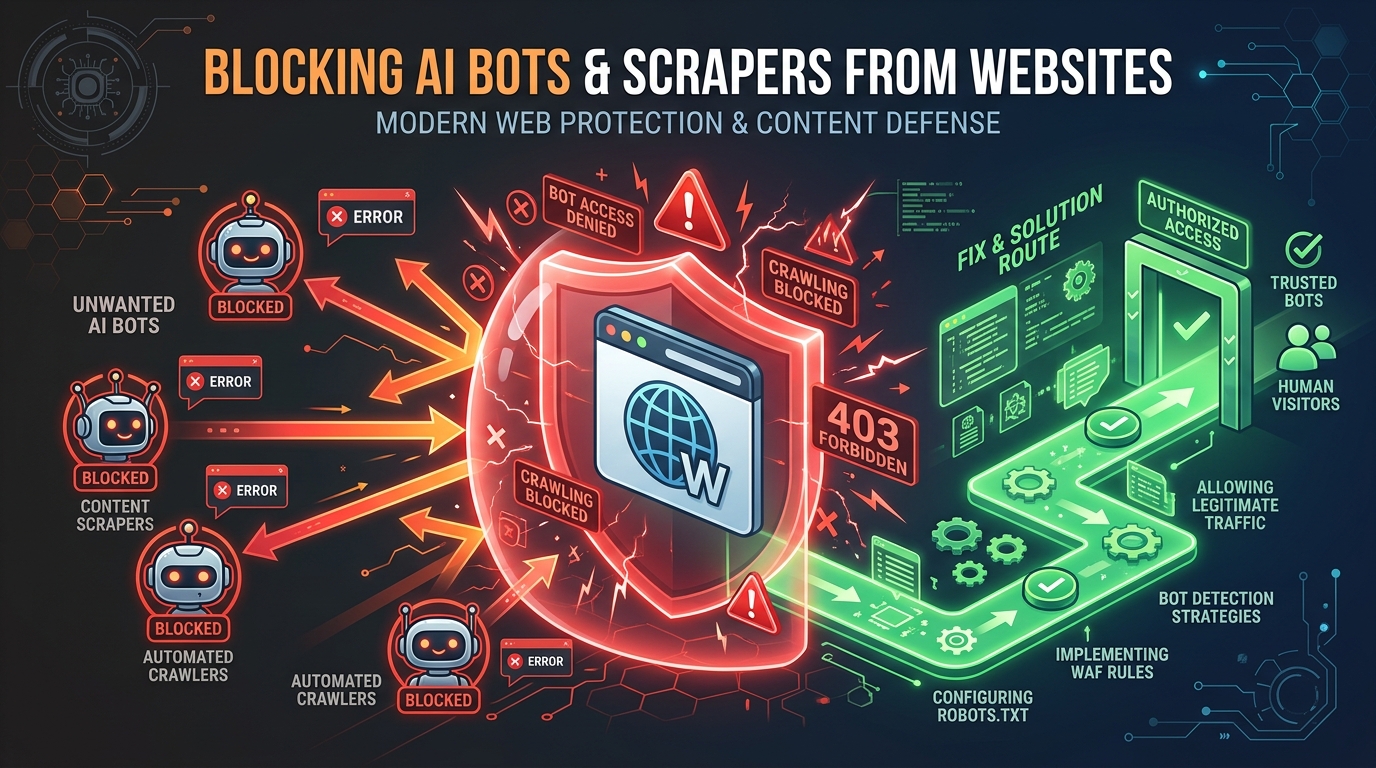

Blocking the wrong bots can cost you AI visibility. Allowing the wrong bots can cost you bandwidth and content. This guide helps you draw the line in the right place.
In this guide you will learn how to choose between WAF blocking and robots.txt for AI. We will keep it practical, with clear steps, visual breakdowns, and specific actions you can take today. The first step in any AI visibility project is to run a free AI crawler check on your website so you know exactly where you stand against the 196 bots we track across 8 categories.
Key Takeaways
- Cloudflare AI Bot Blocking vs robots.txt: Pros and Cons is a practical, repeatable process, not a one-time fix.
- Most AI visibility problems trace back to access, not content.
- You can verify every change with the free AI crawler check and the robots txt validator.
- Document your approach so the whole team applies it consistently.
Blocking Bad Traffic Without Blocking Citations
Security controls and AI visibility pull in opposite directions, so the sequence is designed to keep the two decisions separate rather than letting one silently override the other.
Inventory what is currently being blocked and by what
List the rules in your firewall, CDN and bot-management layer alongside robots.txt. These are usually managed separately and frequently contradict each other, and the security layer always wins.
Verify the identity of the agents you care about
A user-agent string is a claim, not evidence. Confirm legitimate crawlers by reverse DNS or published address ranges before writing rules that trust the header, because spoofing the header is trivial.
Distinguish abusive volume from unwanted purpose
Rate limiting answers a load problem. A robots.txt directive answers a policy problem. Using a block to solve a load problem removes you from answers you wanted to appear in, and it is the most common overcorrection.
Test the external result rather than the config
Run a crawler check from outside your network and confirm the crawlers you intend to allow are genuinely reachable. Configuration review does not catch a rule applied at an upstream layer.
Recheck after every infrastructure change
Bot-management defaults change, CDN features get enabled, and vendors add protections without asking. Validate the file with a robots.txt validator and re-scan on a schedule.
What Edge Controls Against File Directives Do, and What They Do Not
These two are constantly compared as competing products when they are not the same kind of thing. A file directive is a published request that cooperative agents choose to honour. An edge control is enforcement that applies whether the agent cooperates or not. One states intent and the other imposes it, so asking which is better is the wrong question. The right question is which of your requirements need enforcing and which only need declaring.
The reason this cannot be settled by preference is that the bot population is split. A majority of catalogued agents are recorded as honouring robots.txt, which makes the file genuinely effective for them and far cheaper to maintain than any rule set. But a substantial minority do not honour it, and others are recorded as inconsistent or simply unknown. Any requirement that actually matters has to survive that minority, and no file directive can make it. Meanwhile enforcing everything at the edge throws away the one thing the file does that enforcement cannot: it tells well behaved agents what you want in a form they can read before they fetch.
Where People Get Edge Controls Against File Directives Wrong
Use the file to declare intent and the edge to enforce consequences
The division that holds up is by what happens if the agent ignores you. If the answer is that you would accept it, the file is the right home, because it costs nothing and needs no infrastructure. If the answer is that you would not accept it, the file is insufficient on its own regardless of how carefully it is written. Most sites need both, expressing the same policy in two registers, and the mistake is treating the choice as either or.
Keep the two statements consistent, because divergence is the usual bug
When both layers exist they drift. Someone adds an edge rule during an incident and nobody updates the file, so the published policy now says one thing and the enforced policy does another. Cooperative agents read the file, comply with what it says, and are blocked anyway, which is the worst combination available: you lose the citation and you also look as though you invited the fetch. Review both together, and treat a discrepancy as a defect rather than as redundancy.
Understand that an edge rule can fail closed in ways a file cannot
A file directive has a small blast radius. If it is wrong, agents that read it behave differently, and correcting the file corrects the behaviour on their next fetch. An edge rule sits in the request path, so a rule that is broader than intended can remove access for agents nobody meant to touch, immediately and without any signal. That is an argument for testing edge changes from outside and for making them narrow, not an argument against using them.
Choose based on your own operational reality, not on which is stricter
Both layers need an owner and a review habit, and they place the burden differently. A file directive lives in the repository, is reviewed like code, and is easy to reason about. An edge control lives in a dashboard, often outside version control, and is frequently changed by whoever is handling an incident. If nobody owns the dashboard, an edge only policy will decay faster than a file only one, whatever its theoretical advantages. The stricter mechanism is not the better one if it is the one you cannot maintain.
The Control Placement Failure That Hides in Plain Sight
Assuming an edge rule makes the file redundant
The reasoning sounds airtight: enforcement covers everything a request could cover, so why maintain a file as well. What it misses is that the file is the only channel that communicates before the fetch happens. Remove it and cooperative agents lose the ability to respect a boundary they would have respected, so they now discover your policy by being refused. You get the same restriction with worse signalling, and you lose the record of what your policy actually is, which is the thing anyone reviewing the decision later needs to read.
How to Confirm Edge Controls Against File Directives Behave the Way You Think
The check that matters here: Write out your intended policy in one column, then what robots.txt says and what the edge enforces in two more. Every row where the three disagree is either a bug or an undocumented decision.
Where to Go From Here
Control Placement is one piece of a larger picture. The AI bot directory documents every crawler we track with its operator, purpose and safety rating, and the batch checker audits many sites in one pass if you manage a portfolio.
Blocking hostile scrapers while staying visible to search-and-cite bots is a balance, not a switch. Verify both sides with a crawler check.
Your Control Placement Action Checklist
Five concrete steps, specific to what this guide covered. Work through them in order, changing one thing at a time so you can tell which change produced the result.
- □Establish a baseline with an AI crawler checker and write down the score before you change anything.
- □Apply the single highest-impact change from this guide, on its own, so you can attribute the result.
- □Validate the change with the robots checker before it reaches production.
- □Re-measure and compare against your baseline rather than against expectation.
- □Schedule a recurring re-check, because redesigns and security updates quietly undo this work.