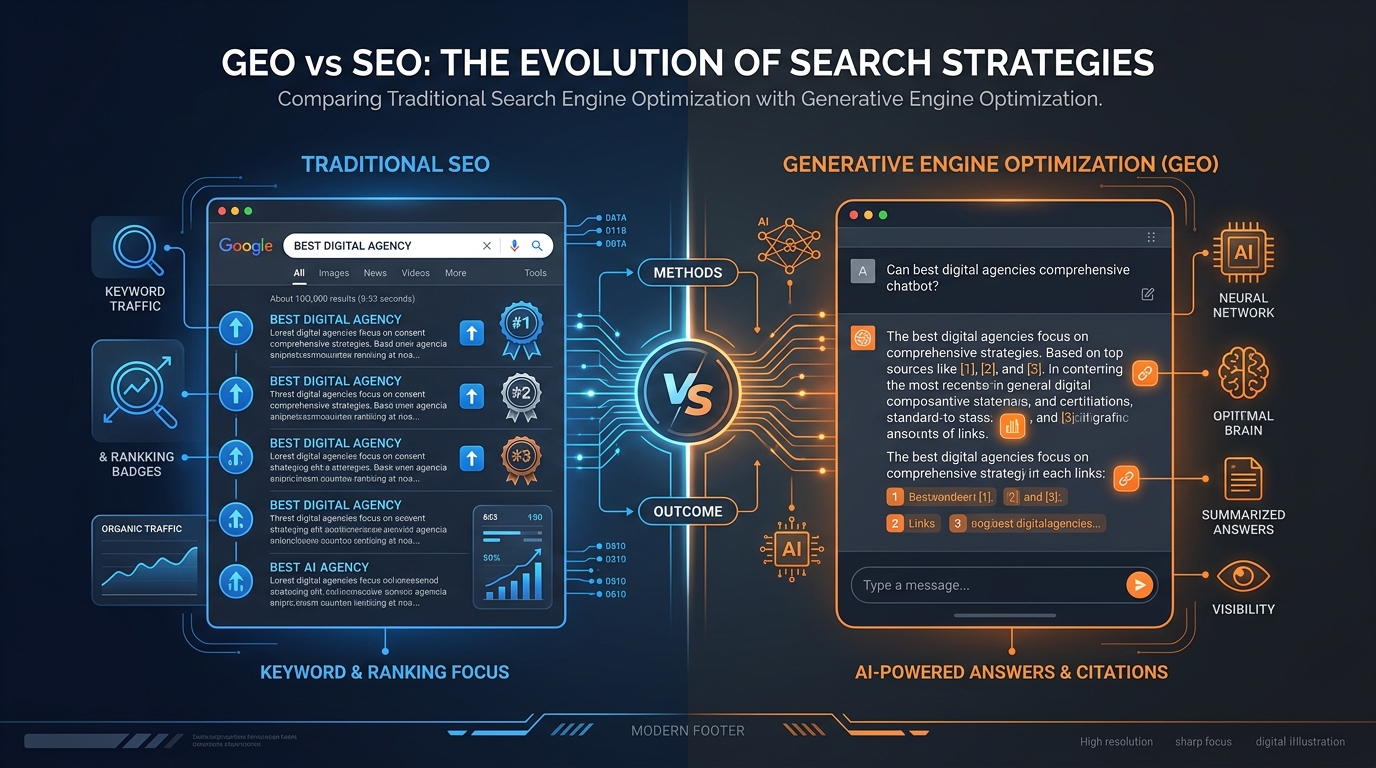

In 2024, you optimized for Google. In 2025, you heard about "AI SEO." Now in 2026, there is a new term everywhere: GEO (Generative Engine Optimization). But what exactly is GEO? How is it different from SEO? And do you need to throw out your SEO playbook and start over?
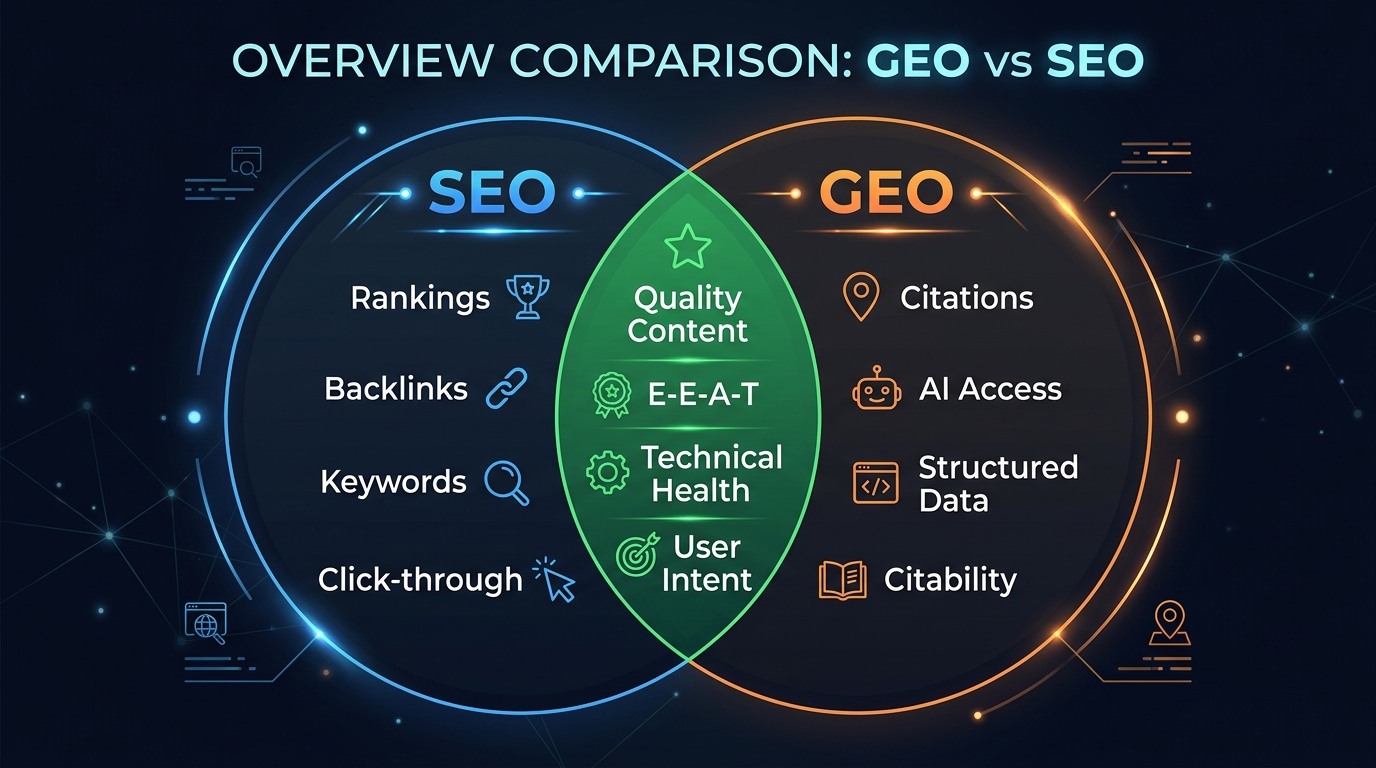
The short answer: GEO and SEO are not opposites. They are complementary strategies with about 70% overlap. But the 30% that is different? That is what determines whether your content shows up in AI-generated answers or gets left out entirely.
This guide gives you the complete comparison: what each strategy involves, where they overlap, where they differ, and a practical framework for doing both. The first step for any GEO strategy is to check if AI bots can crawl your website. If they cannot, no amount of content optimization will help.
What Is GEO (Generative Engine Optimization)?
GEO is the practice of optimizing your website and content to appear as a cited source in AI-generated answers. When someone asks ChatGPT "What is the best way to block AI crawlers?" and the response cites your article, that is GEO working.
GEO targets these AI engines:
- ChatGPT Search (OpenAI) uses GPTBot and ChatGPT-User to crawl websites
- Perplexity AI uses PerplexityBot to find and cite sources
- Google AI Overviews uses Googlebot and Google-Extended for AI features
- Claude AI (Anthropic) uses ClaudeBot for training and search
- Google-Agent (Project Mariner) uses the new Google-Agent bot for agentic browsing
The fundamental difference from SEO: GEO is about getting cited, not ranked. AI engines do not show a list of 10 links. They generate an answer and cite 2 to 5 sources. If you are not one of those sources, you get zero visibility from that query.
What Is SEO in 2026?
SEO in 2026 is still about ranking your web pages in search engine results. But the landscape has changed:
- AI Overviews: Google now shows AI-generated summaries on 30%+ of queries, pushing organic results down
- Zero-click searches: Over 60% of Google searches end without a click to any website
- Intent matching: Google's AI understands user intent much better, rewarding content that truly answers questions
- E-E-A-T weight: E-E-A-T signals are more important than ever for ranking
Despite these changes, Google organic search still drives the majority of website traffic. SEO is not dead. But it is no longer enough by itself.
GEO vs SEO: The Complete Comparison
| Aspect | SEO (Traditional) | GEO (Generative) |
|---|---|---|
| Goal | Rank on search result pages | Get cited in AI-generated answers |
| Primary metric | Rankings, CTR, organic traffic | AI citations, AI referral traffic, brand mentions |
| Visibility format | 10 blue links per page | 2 to 5 cited sources per answer |
| Key ranking factor | Backlinks + content relevance | Citability + authority + AI access |
| Content format | Keyword-optimized long-form | Clear, quotable, question-answer pairs |
| Technical foundation | Core Web Vitals, crawlability, indexing | AI bot access, llms.txt, schema markup |
| Bot management | Googlebot focused | GPTBot, ClaudeBot, PerplexityBot + more |
| Authority signal | Domain authority, backlink profile | E-E-A-T, author credentials, original data |
| Monitoring tool | Google Search Console, Ahrefs | AI Crawler Check, AI search trackers |
The 70% Overlap: What Works for Both
Most of what makes content rank well in Google also helps with AI citations. Here is what carries over:
1. Quality Content
Both Google and AI engines reward well-written, comprehensive content that genuinely answers user questions. Surface-level content that repeats what everyone else says will not rank in Google or get cited by AI.
2. E-E-A-T Signals
E-E-A-T matters for both channels. Author credentials, original research, and brand authority influence Google rankings and AI citation selection.
3. Structured Data
Schema markup helps Google understand your content for rich snippets and helps AI engines extract structured information for citations.
4. Technical Health
Fast loading, mobile-friendly design, secure HTTPS, and clean site architecture benefit both SEO and GEO.
The 30% That Is Different: GEO-Specific Tactics
Here is where GEO requires its own approach:
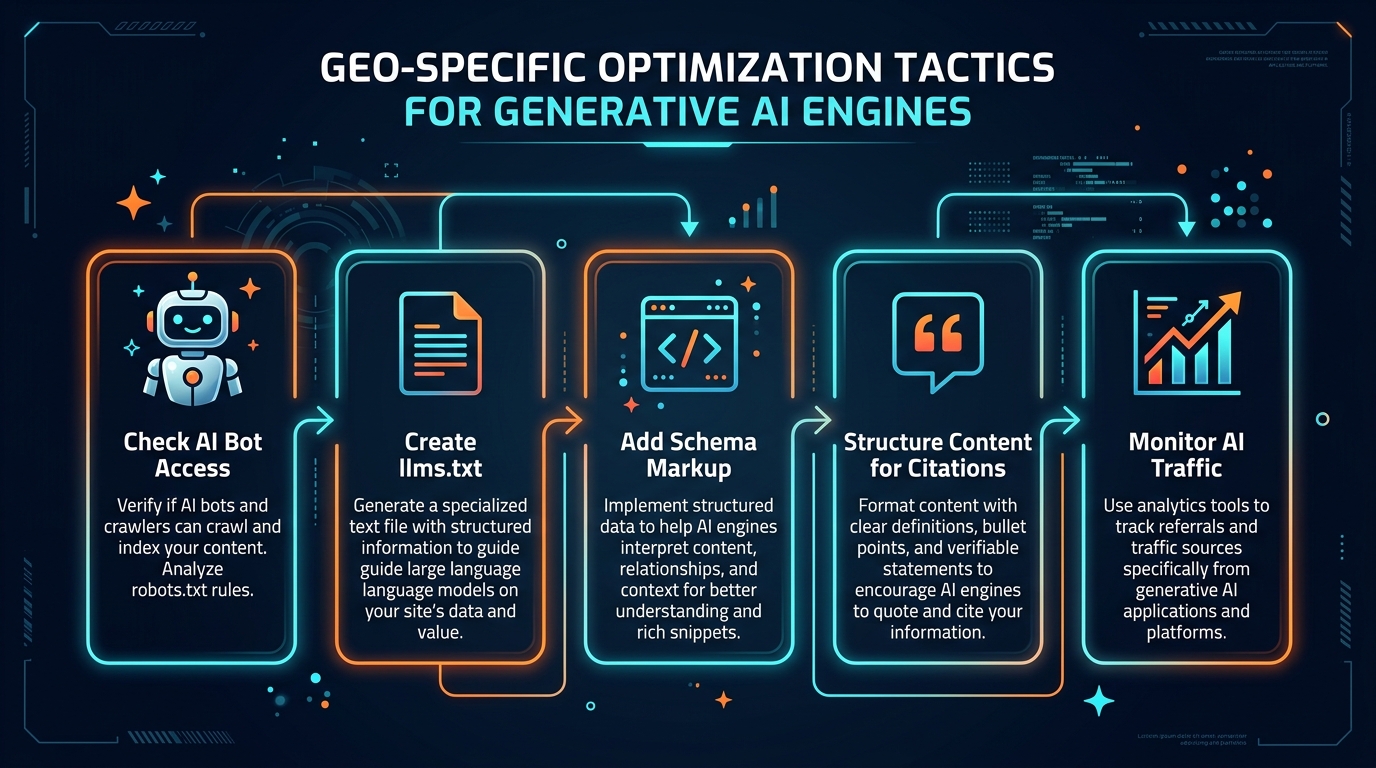
1. AI Bot Access Management
SEO only requires Googlebot access. GEO requires managing access for dozens of AI bots: GPTBot, ClaudeBot, PerplexityBot, Google-Extended, and many more. Each bot has different user-agent strings and different purposes.
Action Step
Run a free AI crawler check on your website to see which of the 196+ AI bots can access your content. The tool analyzes your robots.txt, checks for llms.txt, and gives you an AI Visibility Score from 0 to 100. Most websites score below 50 because they have never optimized for AI bot access.
2. llms.txt File
This is a GEO-only tactic. An llms.txt file helps AI engines understand your website's purpose, authority, and most important content. There is no SEO equivalent because Google does not read llms.txt (yet). Learn how to create one with our llms.txt guide.
3. Content Citability
SEO content is optimized for keywords. GEO content is optimized for quotability. AI engines need to extract clear, specific statements from your content to include in answers. This means:
- Write clear, direct opening sentences that answer questions immediately
- Use headings that match how people phrase questions to AI engines
- Include specific numbers, data points, and definitive statements
- Add FAQ sections with clear question-and-answer pairs
4. Multi-Bot Robots.txt Strategy
In SEO, your robots.txt is simple: allow Googlebot, block bad bots. In GEO, you need a nuanced robots.txt strategy that considers whether each AI bot is crawling for training data (which you might want to block) or for search results (which you want to allow). Our guide to blocking AI crawlers covers this in detail.
The GEO+SEO Framework: Optimizing for Both
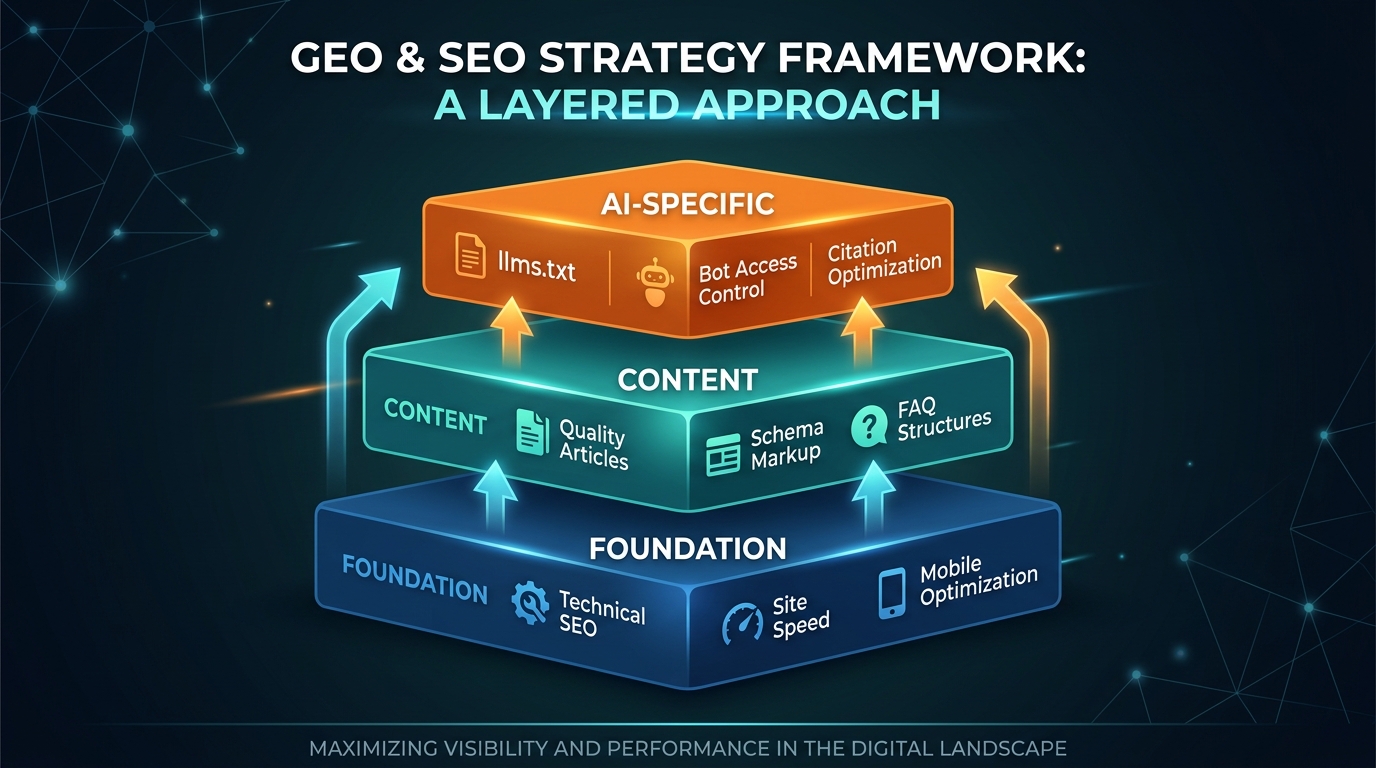
You do not need to choose between GEO and SEO. Here is a practical framework for doing both:
Layer 1: Technical Foundation (SEO + GEO)
- Fast, mobile-friendly, HTTPS website
- Clean site architecture with logical URL structure
- XML sitemap submitted to Google Search Console
- Robots.txt configured for both search engines and AI bots
- AI Visibility Score of 50 or higher
Layer 2: Content Strategy (SEO + GEO)
- Keyword research plus question research (what do people ask AI?)
- Comprehensive, expert-level content with original insights
- Clear headings that match search queries and AI prompts
- Strong E-E-A-T signals on every page
Layer 3: GEO-Specific Optimization
- llms.txt file for AI engine discoverability
- FAQ sections with FAQPage schema on every article
- Quotable content: direct answers in the first paragraph
- Author pages with Person schema and credentials
- AI bot traffic monitoring in analytics
Layer 4: Monitoring and Iteration
- Google Search Console for SEO performance
- AI Crawler Check monthly for AI bot access status
- AI search citation tracking (manually check ChatGPT, Perplexity for your topics)
- Run the AI SEO audit checklist quarterly
Real-World Example: How GEO Changes Your Approach
Let us look at a concrete example. Suppose you run a jewelry e-commerce site (like jemmia.vn) and want to optimize a page about "how to choose a diamond engagement ring."
| Optimization | SEO Approach | GEO Approach (Additional) |
|---|---|---|
| Title | "How to Choose a Diamond Engagement Ring [2026 Guide]" | Same, but add FAQ schema below |
| Opening | Hook, context, then answer | Answer first: "The best diamond is 1 to 1.5 carats, VS1 clarity, G color, for most budgets." |
| Content | Keyword-rich, 2000+ words | Add: original price data, author's experience as certified gemologist |
| Schema | Product, Article | Product, Article, FAQPage, Person (author as gemologist), HowTo |
| Bots | Allow Googlebot | Allow Googlebot + GPTBot + ClaudeBot + PerplexityBot |
The GEO additions are small but powerful. They make the same content accessible and citable by AI engines without hurting your Google rankings. In fact, most GEO optimizations (better structure, clearer answers, richer schema) will improve your Google rankings too.
Common Mistakes When Transitioning to GEO
Mistake: Blocking All AI Bots "for Safety"
Some website owners block all AI crawlers because they worry about content theft. This makes you completely invisible in AI search. A better approach: block training-only bots but allow search bots. Check your current bot access to see what you are blocking.
Mistake: Abandoning SEO for GEO
Google organic search still drives 60%+ of website traffic. Neglecting SEO to focus only on AI citations is premature. Do both.
Mistake: Ignoring AI Bot Diversity
There are 196+ AI bots, not just GPTBot. Each AI engine has its own crawlers. Our AI bot directory lists all of them with their purposes and access patterns.
Mistake: Not Monitoring AI Traffic
If you do not track AI bot visits and AI referral traffic, you cannot measure GEO success. Set up AI bot traffic monitoring in your analytics.
Getting Started: Your First Week of GEO
If you are new to GEO, here is a practical one-week plan:
Run an AI crawler check on your website. Note your AI Visibility Score and which bots are blocked.
Update your robots.txt to allow key AI search bots (GPTBot, ChatGPT-User, ClaudeBot, PerplexityBot).
Create an llms.txt file and upload it to your website root.
Add Article and Person schema markup to your top 5 pages.
Rewrite the opening paragraphs of your top pages to be "AI-quotable": direct answers first, details second.
Add FAQ sections with FAQPage schema to your top 10 articles.
Re-run the AI crawler check to verify your improvements. Set up AI traffic monitoring.
Conclusion: GEO + SEO = Full Search Visibility
The debate "GEO vs SEO" is a false choice. In 2026, you need both:
- SEO keeps you visible in Google's organic results, which still drive the majority of web traffic
- GEO makes you visible in AI-generated answers, which is the fastest-growing source of traffic and brand visibility
The good news is that 70% of the work overlaps. Focus on creating genuinely excellent content with strong E-E-A-T signals, proper technical optimization, and strategic AI bot access. The GEO-specific additions (llms.txt, citability optimization, multi-bot management) are relatively small investments with huge potential returns.
Start now: Check your AI Visibility Score for free and see where your website stands. Then follow the one-week GEO plan above to start optimizing for AI search alongside your existing SEO strategy.